AI and Indian IT
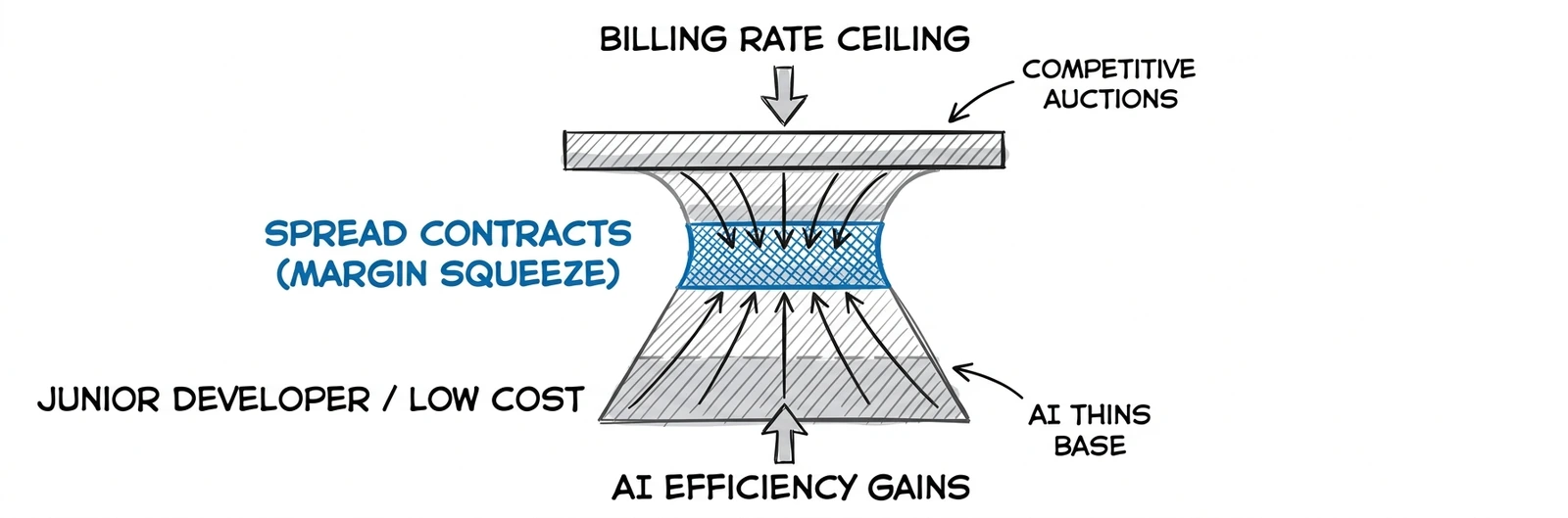
Indian IT’s margin has historically been the gap between what a junior developer costs and what the client is billed. AI is squeezing margins from both ends. And the winners of the future will be very different from the winners of the past.
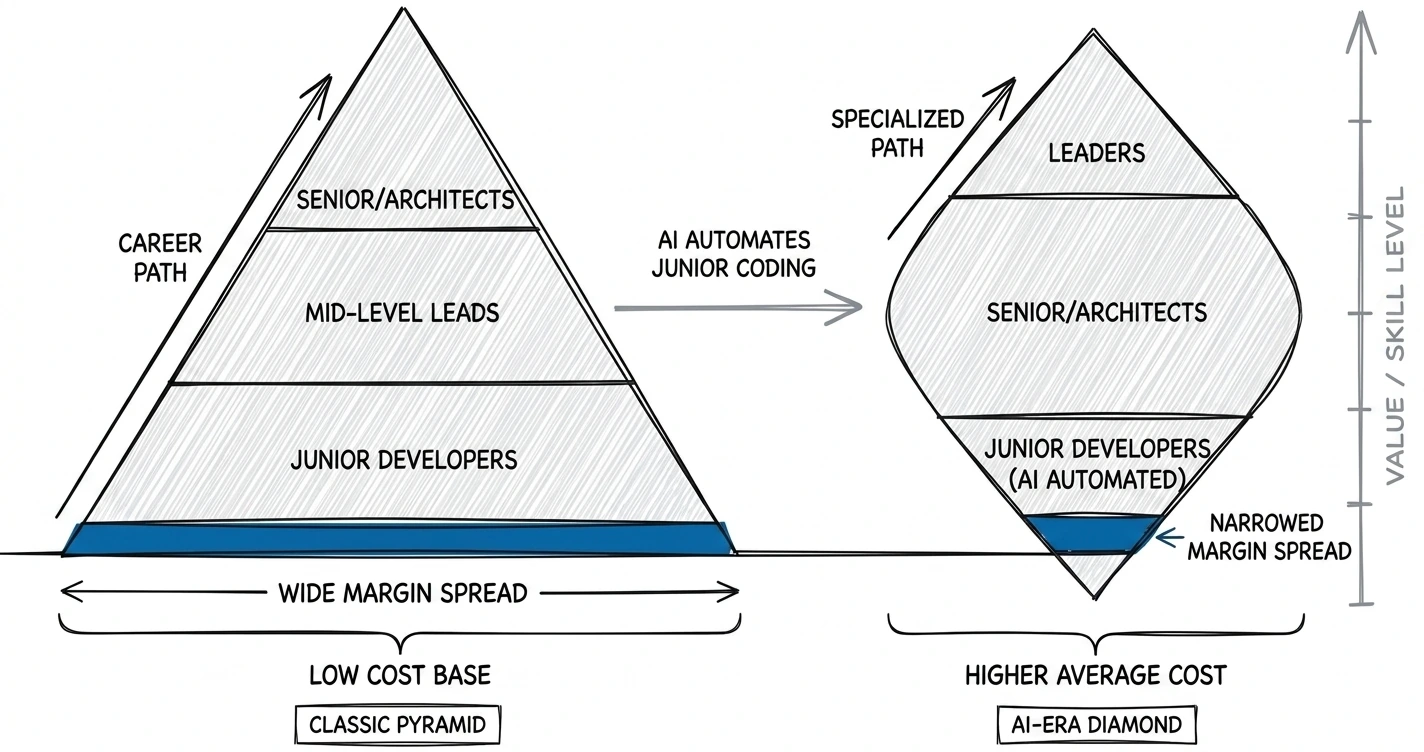
Indian IT’s operating model is usually described as labour arbitrage, a wage gap between India and the West that translates into profit. Most billable hours in a delivery pyramid come from junior developers, whose salary has held around ₹3-3.6 lakh a year in nominal terms for roughly a decade1. The client pays a single blended rate, the weighted average across the team, which prices in enough senior coverage to justify a dollar figure many times what the junior developer actually costs. Workforce costs at the tier-1 firms run at 50% to 58% of revenue2. The operating margin is the gap between those two numbers, and the wider the pyramid, the lower the cost. Today, AI is narrowing that gap from both ends.
Fewer juniors are needed per project
As IT service companies adopt generative AI coding tools, those tools generate boilerplate code, write the unit tests, draft the documentation and flag basic errors, and you need fewer junior resources to ship the same project. And that is already showing in the numbers. As per foundit, the IT industry accounted for 32% of India’s entry-level hiring, a number that is down to 24% today3.
But clients still need architects to design systems and senior developers to own delivery, so the top of the pyramid holds, while the base shrinks. The same output now takes fewer junior people, average team cost rises toward the senior range, and the gap between costs and the billing rate shrinks.
Efficiency gains are being passed on to clients
While in theory, companies should benefit from the kinds of productivity gains that AI tools would deliver, reality is more nuanced. Under time-and-material contracts, the client pays by the hour, so every hour saved by AI is one less hour billed to the client – and so the gain passed on directly to the client without anyone renegotiating. Cognizant reported an even split between T&M and fixed-price revenue; Infosys reported approximately 46% T&M, per their quarterly disclosures4.
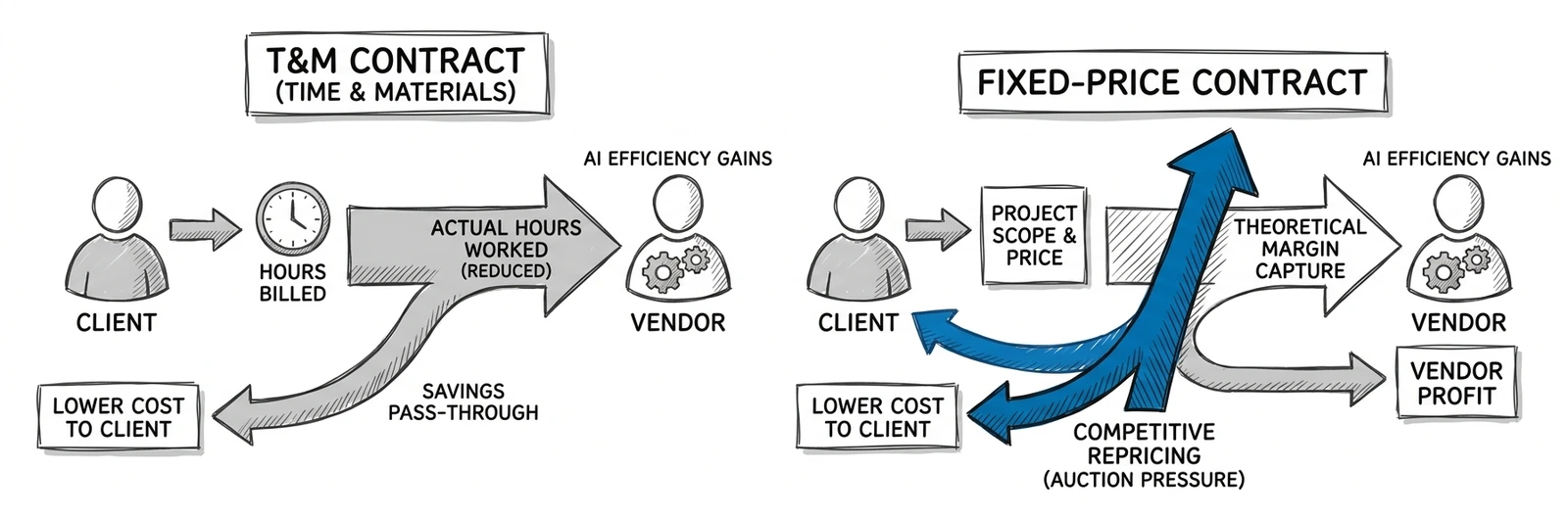
Fixed-price contracts make up the remainder, and they look like shelter. Finish a fixed-scope project with fewer person-hours and the company keeps the difference. Unless of course the client has already worked out that the efficiency gains that these tools are delivering, and is pricing savings into the bid before work even commences. LTIMindtree’s management put a number on it on last quarter’s call:
“Yes, it is fair, but do not look this purely as a deflation... the same requirement or the same deal, I would have priced probably, let us say, 15% higher a year back, but the same scope of work I am picking up at, let us say, 15% less.”5
That 15% reduction is a permanent price cut, taken in a competitive auction before any efficiency has been captured. Faced with competitors who are also AI-enabled and willing to pass through future gains, the vendor is forced to concede. The delivery efficiency meant to compensate comes later, is uncertain, and introduces commercial risk once the contract is signed.
Infosys’s CFO described the same thing from the revenue side: “client expectation on productivity, along with high competitive intensity is resulting in softer increase in price versus our expectations.”6 Clients have worked out that AI is cutting vendor costs, and competitors are bidding as though it already has. No vendor can hold out without losing the deal, and every contract priced at the new rate locks the lower price in for its duration.
What the price cut needs to pay off
LTIMindtree’s management framed the concession as temporary compression. Take the lower price now, and ensure that AI-augmented efficiency drives delivery costs lower, ideally lower than the price cut. If that works, the bet pays off.
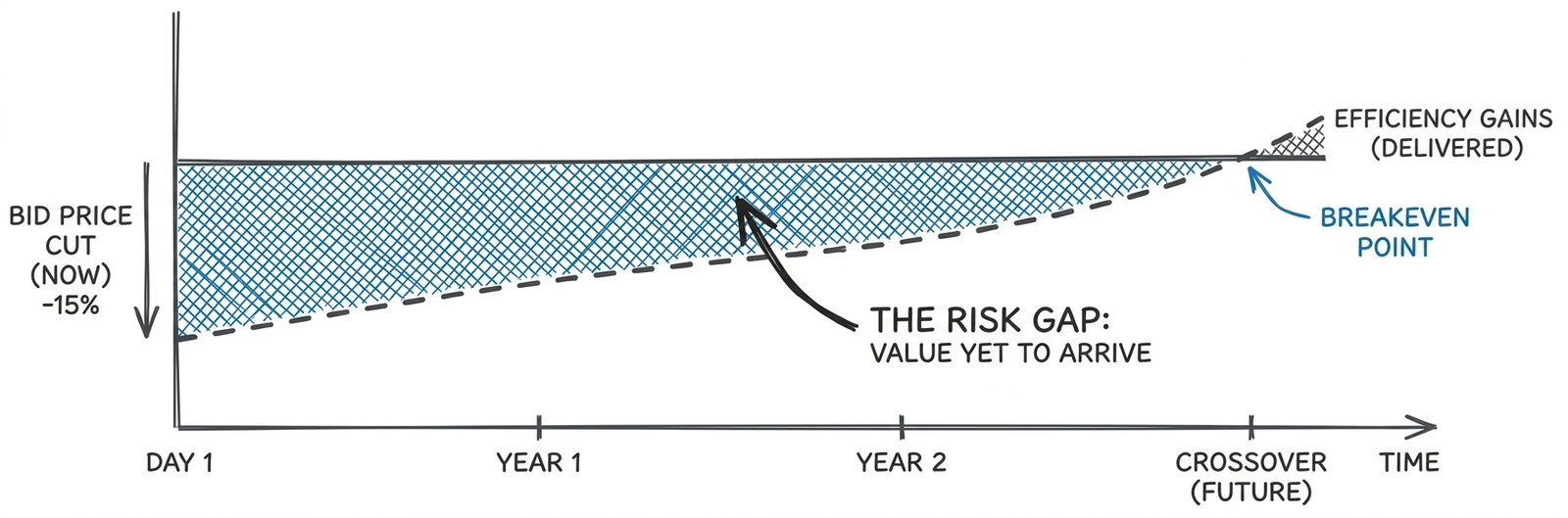
That needs two things to be true at once. Delivery efficiency has to arrive at the project level reliably and quickly enough to close the gap. But software productivity gains are project-specific. Wipro’s chief executive put the range plainly on this quarter’s call: on greenfield Python work the productivity is significantly higher, while on complex legacy code headed into a poor target environment it comes down significantly7. And if another round of repricing arrives before that efficiency is captured, then the vendor who conceded 15% without having earned it back will be asked to concede more.
TCS is already describing productivity gains of 10% to 15% passed through at renewals, which puts the market clearing rate for such concessions in that range8. At the far end, Tech Mahindra’s chief executive describes competitors baking 70% to 80% productivity benefits into five- and seven-year deals, commitments he says he would not try to match, and rest on gains “not visible today without very significant process or system changes by the client”9.
J.P. Morgan equity research calls this phase an “AI deflation” cycle, in which efficiency gains on legacy code maintenance shrink project billings faster than new AI engagements replace them10. Against this backdrop, for any company to grow, the bet would be that new work grows faster than the old work shrinks.
Where we differ
The consensus reading is that Indian IT is now uninvestable: a structurally deflating industry, priced accordingly, and best avoided. We are not in that camp. Our view is that these dynamics will not affect every company in the same way, and the tectonic shift underway, that shows up as a headwind for most companies, will show up as a catapult for a select few.
And to uncover them, one has to ask different questions from the past. The questions that served for two decades were about the employee pyramid and the onsite-offshore ratio, both of which measured how cheaply a firm could staff a given piece of work. AI is making the answers to those questions matter less and less, because the cheap base they measured is what is being automated away. A firm can have an excellent pyramid and still see deflating revenues.
What will set companies apart
Limited legacy. Hexaware’s management guides to 20% to 25% gross deflation over four years on traditional IT services11. Compounded, that is close to 6% of revenue a year the company has to replace before a single point of growth shows up. And on its own disclosure there is no protected corner: the offsetting services launched in 2026, so none of them existed in the base year, and the deflation applies to essentially the whole book.
Execution agility. Whether the firm delivers on an outcome that is critical to the client’s own business – whether the claim is paid, the campaign lands on target, or a differentiated product while its competitors are still selling hours. Outcomes are harder to deflate than effort, because the client is buying the result rather than the time. Winning companies will lean into the accelerated development loop that AI coding tools and harnesses unlock – delivering better, and delivering faster for their clients.
Commercial flexibility. Outcome-based and product-based selling invert the cash profile, and not all companies are up for it. Expenses land today, and revenue arrives later – and only if the outcome lands. That is margin compression on day one, and a firm that cares about margin management will not be keen to accept it.
Companies that combine all three will come out of this period stronger than they went into it. The signal we watch for is revenue acceleration, because that is the undeniable signal that AI has stopped being a headwind, and is acting as a propellant.
Sources
- Infosys standard Systems Engineer fresher offer, ₹3.6 lakh, 2026; the nominal entry-level range held at ₹3 to ₹3.6 lakh through the prior decade. Infosys also runs specialist tracks paying materially more. The figure here is the mass campus track, which is the pyramid base under discussion. ↩
- ICRA research and tier-1 company annual disclosures, workforce cost as a share of revenue. ↩
- Foundit Insights Tracker, July 2026. IT’s share of all-sector entry-level hiring in India, 32% to 24% year on year. ↩
- Cognizant and Infosys quarterly disclosures and SEC filings, time-and-materials against fixed-price revenue mix. ↩
- LTIMindtree management, Q1 FY27 earnings call. ↩
- Infosys Chief Financial Officer, Q1 FY27 earnings call. ↩
- Srini Pallia, Chief Executive Officer, Wipro, Q1 FY27 earnings call, 16 July 2026. ↩
- Tata Consultancy Services, Q1 FY27 earnings call, on productivity pass-through at renewals. ↩
- Mohit Joshi, Chief Executive Officer and Managing Director, Tech Mahindra, Q1 FY27 earnings call, 16 July 2026. ↩
- J.P. Morgan equity research, on the “AI deflation” phase. ↩
- Hexaware management, AI Day, 21 August 2026. Guidance of 20% to 25% gross deflation over four years on traditional IT services, which compounds to 5.4% to 7.0% a year, midpoint 6.0%. Gearing and the CY25 revenue split from Meritus analysis. ↩