Eye on India | FY26 Q3
The tariff wall came down, corporate capex hit a six-year high and credit finally inflected. The rupee broke 90 anyway, and under the index it was brutal.

March marked a year of the Meritus India Fund, which makes this issue a reasonable place to say what the year was actually like. It was intensely demanding for bottom-up stock picking.
The market spent twelve months absorbing 50% punitive tariffs, several geopolitical conflicts, a depreciating rupee, and an AI narrative that went from promising to transformational to frightening. Underneath all of it, the Indian economic engine kept running, while foreign investors kept selling and held India at a decadal underweight.
When the macro gets loud, we go back to fundamentals and read the calls.
The tariff wall came down
India’s trade-weighted average tariff into the United States went 4.0%, then 9.3%, then 12.5%, then 30.0% at the peak of the punitive regime. By this quarter it had settled at 14.5%.
A Supreme Court ruling lowered the general rates and the punitive tranche was removed, leaving an 18% reciprocal rate. That is still four times the pre-2025 level, and exporters are not back to where they were. But the direction reversed inside a single quarter, which is not what anyone was underwriting in the summer.
Corporate capex hit a six-year high
Growth in private companies’ net fixed assets reached its highest level in six years.
The composition matters more than the level. The private sector’s share of total capex rose from 21% in March 2025 to 36% by December. Credit growth came along with it, returning to roughly 1.5 to 1.7 times nominal GDP growth, its historical range when the cycle is working.
For anyone who has spent several years waiting for private capex to replace government spending, this was the quarter the data stopped being a forecast.
The rupee broke 90 anyway
Low inflation through the first half narrowed the gap between nominal and real GDP growth to an unusually thin margin. Companies grow their reported revenue by less when there is no inflation to help.
Then food inflation returned, and the rate-cutting cycle paused. The rupee broke 90 and underperformed most emerging market peers.
AI hit IT hardest
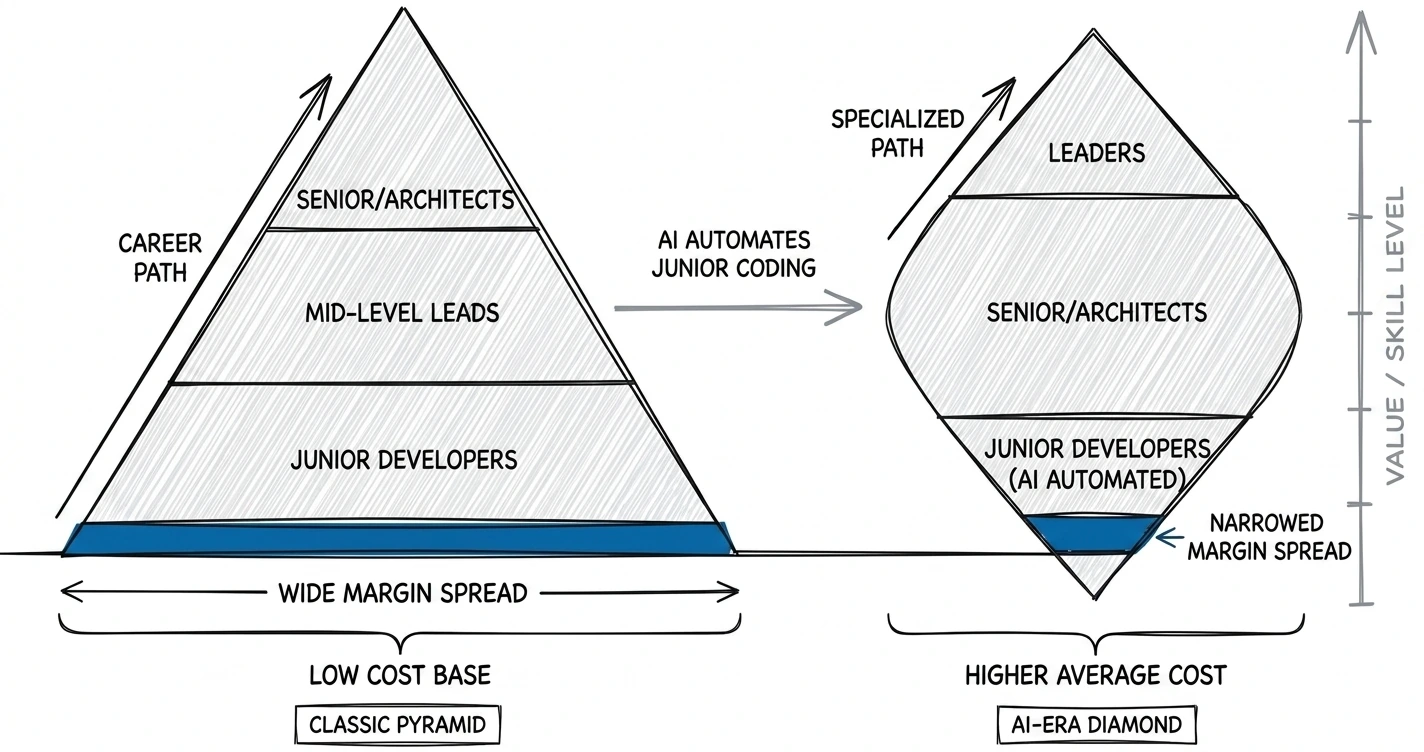
The Nifty IT index spent the quarter being repriced. We described the rotation in the deck as short bits and long atoms, which is roughly what the flows did.
Inside the companies, the picture is less uniform than the index. One engineering services business told us it has filed 229 patents in AI and GenAI alone, and has moved AI from pilots into production-grade deployments across engineering, manufacturing, mobility and medtech. Another is compressing its own engineering headcount by automating support on its internal data. A third has built small language models tuned for education, on the argument that a teacher cannot afford a wrong answer and a general-purpose model gives you one often enough to matter.
What separates them is whether the AI makes their own product better or their billable hours cheaper.
An inverted demand pyramid
A large retailer gave us the cleanest numbers in the deck. Over nine months, same-store sales grew 13% to 14% at premium price points, 9% in the middle, and 6% at the opening price points.
That is the K-shape in one company’s own data, and it points at where the volume is not.
Two other consumer observations sat alongside it. A quick service restaurant chain pointed out that in a $60bn Indian food services market its competition is bhatura chana, dosa, idli and biryani, and that the frequency of pizza is about three times a year. A hotel group noted that Western hotel economics run on 60% to 80% of revenue from room rates, while an Indian luxury brand runs at under 50%, with food, beverage and events carrying the rest.
Both are arguments that the Indian version of a familiar business model is not the Western one with lower prices.
Under the index, it was brutal
The headline indices did not describe what the quarter felt like. Median twelve-month drawdowns across the Nifty 500 excluding the Nifty 50, and worse in microcaps, were far deeper than the index level suggested, with a small share of stocks holding above their 200-day moving averages.
Foreign investors kept selling throughout. Domestic SIP flows kept buying. That has been the shape of this market for two years now, and it is the reason the index and the median stock have told different stories.
What we took away
Tariffs receding, capex inflecting, credit normalising, and a market that punished almost everything outside the largest names. The economy and the market were not describing the same year.
Special thanks to Viraj for helping put the issue together, and to Viraj, Jayesh and Jayant for being partners on this journey.
Onward.
Read the full issue – 97 pages, across macro, platforms, consumer, financials, industrials, services and healthcare.