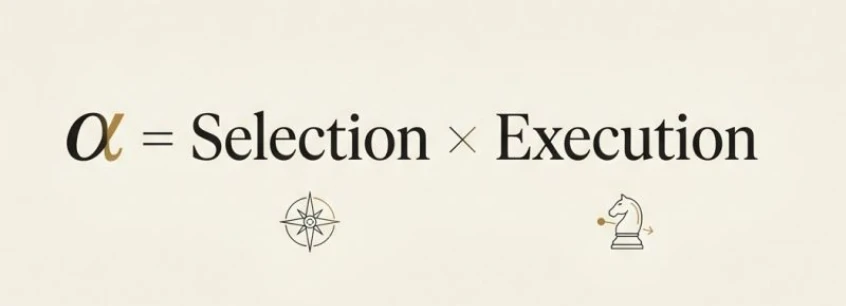
Alpha = Selection × Execution
A simplified decomposition, arrived at in a journal: what you pick, and what you do with what you picked. Error looks different in each.
Alpha. As investors, we are all seeking it. But what is it really? And what drives it?
A few weeks ago I was writing in my journal, trying to pin this down. Not what produces alpha in any particular case, which can be highly contextual, but the thing itself. The simplified decomposition that I settled on was this:
Alpha = Selection × Execution
Selection is what you pick. Which businesses do you own, and under what setup/framework did you buy them? And more importantly, which opportunities did you reject along the way? A portfolio is the sum of its selections and the best investors I’ve watched are ruthless here. They know what they’re looking for, and things that don’t fit are quickly rejected. Error shows up here as buyer’s remorse: when you say yes to a story instead of a thesis, when you chase rather than verify, when you agree to look at something because it’s “cheap” even though it does not fit your frame.
Execution is what you do with what you picked. Timing, sizing, follow-through. This is the gap between thesis and outcome. Error shows up here as fear: both the fear of missing out, and the fear of capital loss. And so you abandon your own process under pressure, as you rush rather than receive, hold an investment too long even when the evidence says otherwise, and sell into the depths of panic.
Which one is more important? Ultimately, selection is paramount – your portfolio cannot outrun the performance of its underlying stocks. But as more companies list, and as more information is available, the approach that feels right to me is to tighten rather than loosen my filters.
But execution matters too. Good execution can protect capital on an ordinary idea, and terrible execution on a great idea can round to zero. And when both selection and execution are great: lollapalooza.
A few years ago, a mentor made the point to me about how there is great power in restriction. I don’t think I fully appreciated the point he was making until recently. When it comes to investing, less can genuinely be more.
Originally published on LinkedIn, 16 April 2026.