Eye on India | FY26 Q4
The quarter was inflecting until the West Asia war arrived. It hit the cost line and left demand alone. FY27 turns less on the oil price than on a capital account that has gone from a $90bn surplus to nothing.

We read each quarter from the bottom up, through the earnings calls, across the seven sectors we cover. FY26 Q4 was unusually easy to read, because the shock that arrived hit one side of the economy and left the other alone.
For most of the quarter the Indian economy was inflecting. Credit growth re-accelerated to 16%, bank asset quality sat at its cyclical best, GST collections compounded, and private capex was finally taking over from the state. Then the West Asia conflict arrived.
It hit cost. Transits through Hormuz collapsed by 95%, India’s crude basket went to $14 above Brent, and freight rose 85%. Demand did not move. Across truck sales, credit, vehicle registrations, GST and power, the high-frequency indicators stayed double-digit or accelerated straight through the shock.
The margin fell on pass-through
Anurang Jain told Endurance’s analysts that the quarter’s EBITDA margin should have been 13.3% rather than 12.6%, and that the gap was “a non-value-add increase, we don’t make any money on it.”
That arithmetic made a lot of March quarters look ugly. When an input cost jumps, a manufacturer passes it through: revenue and cost both rise by the same rupees. Profit per unit is unchanged, but it is now divided by a larger revenue number, so the percentage margin falls. Aarti Industries saw benzene, sulphur, aniline, toluene and methanol move more than 60%. Genus Power, sitting on fixed-price contracts, absorbed the whole of it.
Pass-through catches up over a quarter or two. The margin line will look bad again in Q1 and then recover.
Net FDI has almost stopped
Net foreign direct investment into India fell from a $44bn peak in FY21 to $1.7bn in the first ten months of FY26.
The cause is less foreign investors losing interest than Indian companies going abroad. Outward FDI ran at roughly $40bn over the first eleven months of FY26. India is now exporting capital at close to the rate it imports it, and the capital account surplus has gone from about $90bn in FY24 to near zero.
Every previous rupee shock was a current-account story: an import bill India could not cover. This one sits on the capital account, which moves with where companies and foreign investors choose to put their money rather than with the import bill. The RBI has spent $205bn smoothing the adjustment, and almost none of it appeared in the repo rate or the spot rupee. It went through open-market operations, dollar swaps and a record short forward book, which leaves an unwind to be managed in FY27.
The rupee is down 12% since March 2025, a fall beaten only by the Turkish lira, and that is with $689bn of reserves and eleven months of import cover behind it.
Private capex takes over
The handoff showed up in order books before it showed up in announcements.
L&T’s order book went from 21% private in March 2025 to 39% a year later, across thermal power, real estate, semiconductor fabs, data centres and solar EPC. CG Power took transformer capacity from around 18,000 MVA to nearly 65,000 in a year. It is still hearing, in Amar Kaul’s words, “give us more, give us more.” GE Vernova T&D has pulled state utility exposure below 2% of a record backlog.
New project announcements did dip during the quarter, as you would expect while a war is running. Projects already on the ground kept moving, and stalling rates sit at multi-year lows. The FY27 question is whether announcements restart once the uncertainty clears, and the order books suggest the intent is there.
AI arrives twice, doing opposite jobs
In manufacturing it is simply demand, and it is physical. Cooling, transformers, gensets, castings, ceramics. Aeroflex described a market going from about $3bn to $21bn over five or six years.
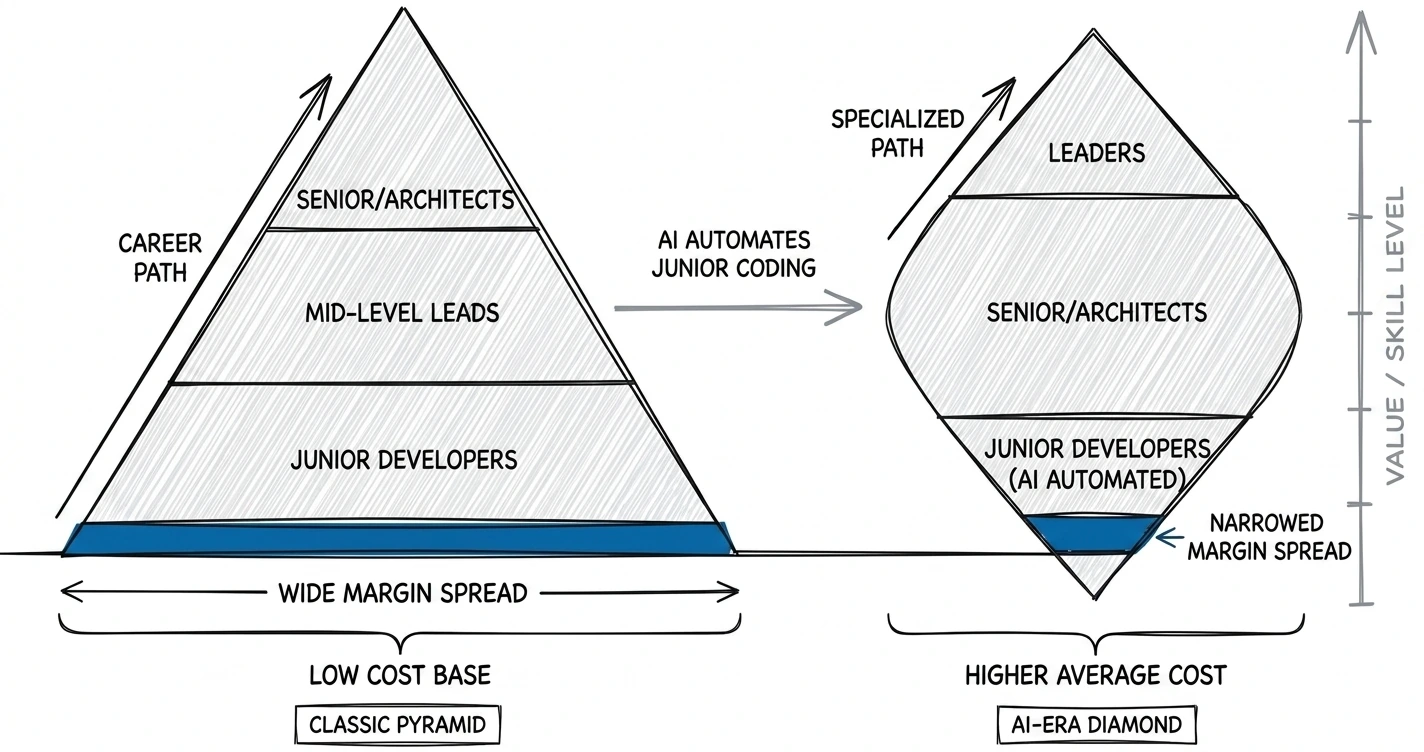
In services and platforms it works the other way. Where the work is billed by the hour, the hours fall and the revenue falls with them. Where it is billed on the outcome, the same tooling widens the margin. HCLTech put numbers on it: roughly 40% of the industry at risk of shrinking 3-5% a year, and 55% positioned to grow at 10% or better. The companies that read this early are repricing. More than 80% of KPIT’s new contracts are now fixed-price, and it is converting the time-and-materials book behind them.
The same divide runs through platforms. Businesses that own their data, or the physical network a transaction has to run through, hold up as agents begin to transact. Pure aggregators sit between a customer and a supplier who can now find each other without them, which is a harder position to defend than it was a year ago.
Banks provision ahead of the shock
Asset quality across banks and NBFCs was at its cyclical best this quarter. Banks are nonetheless building provisions, against an asset-quality hit they expect roughly two quarters out as the cost shock works through borrowers.
The provision lands in the P&L now, and the loss it anticipates may never arrive. Watch whether those provisions get released or consumed over the next two prints.
With credit clean, competition has moved to funding. The argument on the calls was about where deposit growth runs out, not about who to lend to.
The K-shape moved inside the P&L
The K-shape is not new; what has changed is where the line falls. It used to separate premium companies from mass-market ones. It now runs through individual companies: the same firm reports a thriving premium tier and a stalled mass tier in the same quarter. GST cuts and inventory drawdown shielded consumers from most of the input-cost pressure this time, which is why demand held. Those price hikes are still coming.
Whether premium buyers keep paying once the hikes land is the question for FY27, and we do not think anyone knows the answer yet.
Turning work away
In six unrelated industries – auto components, power EPC, food delivery, cash logistics, electronics manufacturing and general insurance – management teams said a version of the same thing. They are turning down business they do not want.
Motherson: “top line is vanity, bottom line is sanity, cash in the bank is reality.” KEC International has stopped taking any order with negative cash flow. Syrma SGS will sacrifice growth rather than lengthen its working capital cycle. ICICI Lombard, asked about a competitive segment, answered that it wants to participate but will not chase.
Companies talk about discipline in every cycle. Doing it while order books are full and demand is intact is less common, and it is a better signal than the same words spoken in a downturn.
The capital account decides FY27
Crude sets most of it. Kotak’s FY27 matrix runs three cases. At $65 the macro normalises and the RBI can hold. At $95, its base case, the current account deficit widens toward 2.5% and the rupee runs to 93-99. Growth slows to about 6%, and rate hikes likely arrive in the second half. At $105 the balance-of-payments deficit widens sharply, and the hikes come earlier and go further.
The bigger question is the capital account. It either recovers on its own, as the war fades and foreign investors come back, or the adjustment has to come through the current account instead. That second route means compressing demand.
For now, demand is the part of the Indian economy that has not broken. The vulnerability is on the cost and supply side. That was true across all seven sectors we read this quarter, and we will check it first in the June prints.
Read the full issue – 226 pages, across macro, cross-cutting themes, platforms, financials, consumer, industrials, manufacturing, services and healthcare.
A shorter version of this was published on LinkedIn on 8 June 2026.