The Non-Lending Flywheel
Insurance, wealth, asset management, broking, exchanges. Businesses that look quite different, but rhyme when you look closely.
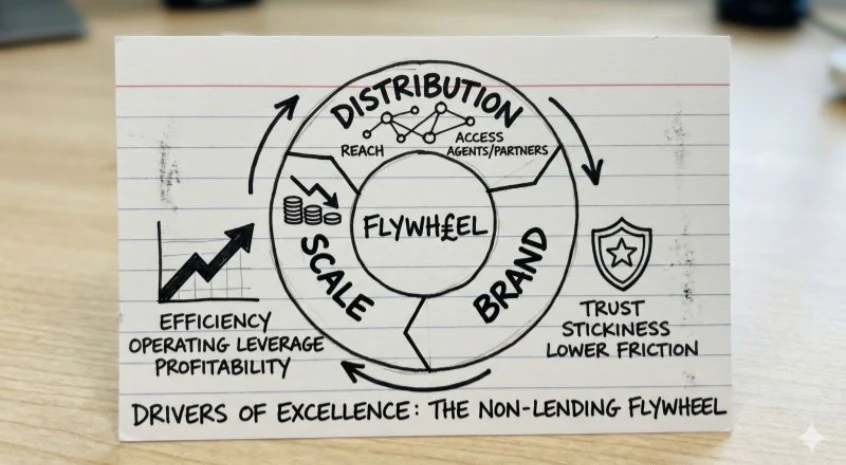
Non-lending financials: insurance, wealth, asset management, broking, exchanges, market infrastructure. Businesses that look quite different, but rhyme when you look closely.
Viraj Yadav from our team recently finished a deep dive across this corner of the Indian market. He worked through each sub-sector to determine what separates the great from the good: the drivers of excellence, and the markers of how it shows up in the metrics. The fun bit came at the end, when we stepped back and asked: across all these sub-sectors, which patterns keep showing up?
We found three: distribution, brand, and scale.
Distribution. In financial services, most products are commodities or quasi-commodities. Which means distribution can make the difference. Consider LIC: over a million agents, still 55-60% of individual new business premium, over two decades after private competition arrived. Or the HDFC group – HDFC Bank customers are natural customers for HDFC Life, for HDFC AMC, for HDFC Securities. The pattern holds regardless of size: as true for a boutique wealth manager as for a frontline life insurer or a mammoth mutual fund house. Distribution is the necessary precursor to growth.
Brand. It may seem odd to talk about brand in the same breath as commodity products. But that is where brand’s work becomes visible. Not in the form of pricing power: commercial terms are roughly comparable across peers, but in the form of stickiness and reduced friction. Both HDFC Life and ICICI Lombard have higher retention ratios than mid-tier peers, partly on account of the peace of mind customers derive from their brands, resulting in higher recurring revenues and lower acquisition costs. Brand can also catalyse distribution, since a known name opens doors a new one cannot. Brand is less about what it lets you charge, and more about what it lets you never spend.
Scale. When gross margins are roughly comparable, scale does the heavy lifting. The gap is sharper than most expect. HDFC AMC runs at an operating margin in the high 70s, among the highest in global asset management, against mid-tier Indian AMCs at 40-50% on comparable TER structures. Same revenue per rupee of AUM, but very different cost absorption. This is scale at the macro level: marketing, technology, compliance, and G&A scale sub-linearly with size, and the bigger the base the less the drag. It shows up at the micro level too, in the productivity of the employee or relationship manager, and in assets-per-branch gaps running several-fold between top insurers and smaller peers.
Real power emerges when a company combines all three into a self-reinforcing flywheel: the brand amplifies distribution, distribution builds scale, and scale strengthens the brand. Rather than being a drag on growth, size becomes an accelerant. And identifying the point of take-off, when the flywheel begins to pick up self-reinforcing speed, can be one of the most rewarding moments for a long-term investor.
Originally published on LinkedIn, 21 April 2026.